UE5: Speeding up ISMC instance removal by 6200× with SetRemoveSwap()
tl;dr If you do not need stable instance ordering, call
SetRemoveSwap()onInstancedStaticMeshComponentto massively speed up instance removal.
Unreal Engine’s InstancedStaticMeshComponent (ISMC) allows the creation of many instances of a mesh without additional per-instance GPU draw calls.
When removing instances, the instance ordering is maintained by shifting the remaining instances to fill the gap.
This operation has O(N) complexity i.e. the cost scales linearly with the number of instances.
For short-lived and high-volume entities such as projectiles, the cost can be immense.
ismc->SetRemoveSwap() allows ISMC removals to use a swap-based removal path, where the removed instance is swapped with the final instance instead of shifting the remaining instances down.
This is the same idea as TArray<T>::RemoveAtSwap.
The trade-off is that instance ordering is no longer preserved.
If you keep related instance data in parallel arrays, those arrays must also use RemoveAtSwap() to stay in sync with the ISMC.
Comparative Benchmark
To evaluate the effect of SetRemoveSwap(), I ran a 20-second benchmark of my game that peaked at over 20,000 ISMC-based projectiles.
The only difference between the two runs was the use of SetRemoveSwap().
Instances were removed using RemoveInstances with instance indices sorted in reverse order for maximum performance.
My core system specs are:
- AMD 5800X3D
- NVIDIA RTX 5070
- 64 GB DDR4 RAM
Results overview
The following table describes the longest frame in each run1. The two screenshots show a general overview of the frame times and number of ISMC instances (peak counts are given in the table).
SetRemoveSwap? |
Frame time (ms) | FPS | ISMC instances |
|---|---|---|---|
| Yes | 31.43 | 31.8 | ~24,000 |
| No | 493.68 | 2.0 | ~27,200 |
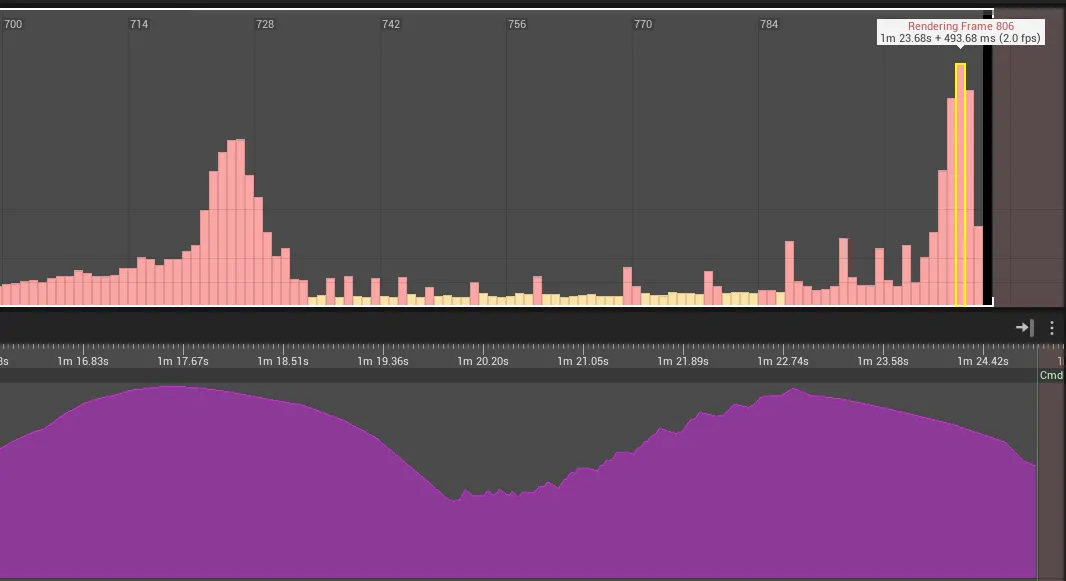
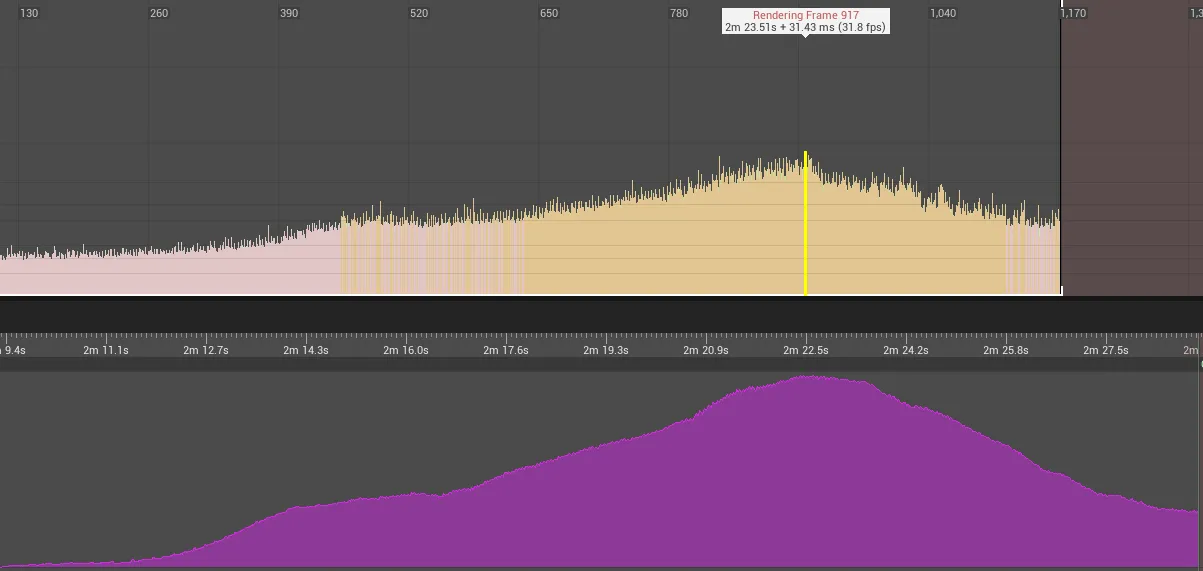
The performance difference is night and day.
Without SetRemoveSwap(), the game becomes effectively unplayable with two large spikes in the frame times grinding the game to a halt.
In contrast, with swap-based removal, the frame times have a gentle rise to a single peak of 31.4 ms (31.8 FPS) and then steadily fall to 18.6 ms (53.8 FPS) by the end.
Longest frame
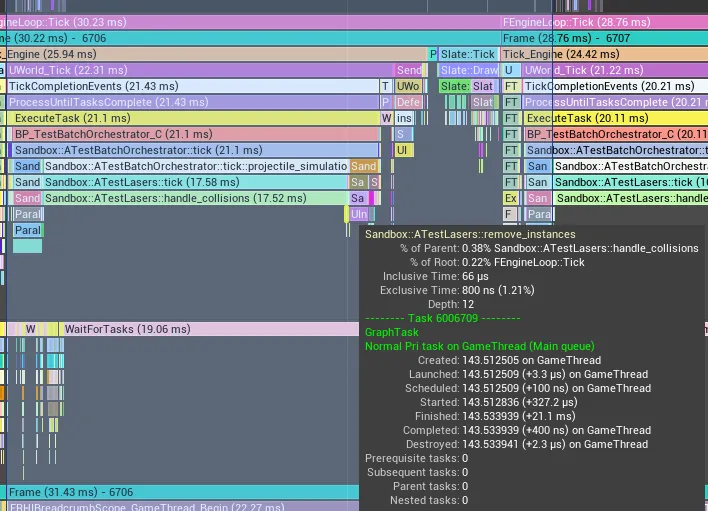
The following two figures show flame graphs for the longest frame in each run.
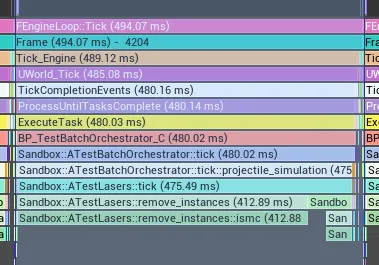
Without SetRemoveSwap(), the instance removal took 412.72 ms, dominating the frame time (83.5% of the total).
The swap-based removal time is so small that it cannot be seen with the naked eye at the same zoom level.
It consumes only 66 microseconds, 0.21% of the frame.
Compared to 412.72 ms without SetRemoveSwap(), 66 μs for the instance removal is roughly 6,200× faster.
Takeaway
If your gameplay does not depend on stable instance ordering, SetRemoveSwap() should be strongly considered for high-churn ISMCs.
The performance benefits can be enormous for ISMC workloads that frequently remove instances. I would encourage Epic to highlight this setting in the official ISMC tutorials.
-
The instance count differences are likely due to load-related timestep changes between the two runs. ↩